
Bifold Doors vs. Sliding Doors: 6 Key Differences to Know
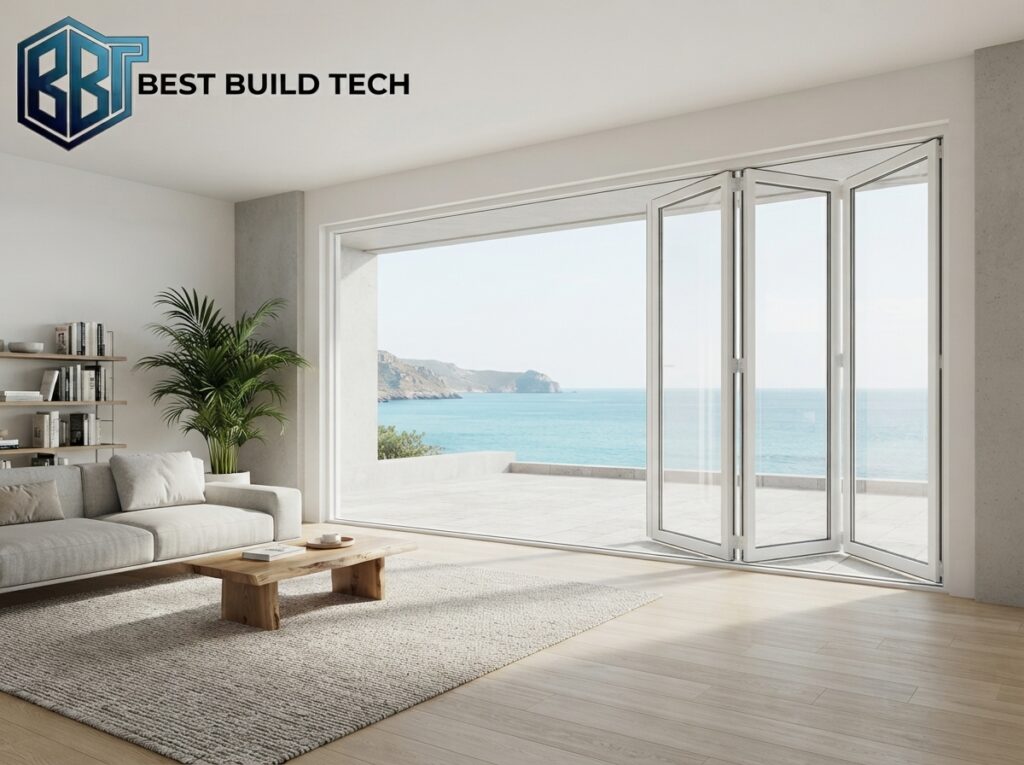
One of the most common questions I get from homeowners planning a remodel is whether to go with bifold doors or sliding doors for their patio opening. It’s a fair question, since both styles bring in more light and create a stronger connection between indoor and outdoor spaces, but they operate very differently and work best in different situations. Here’s the same breakdown I give homeowners in person when they’re stuck deciding between the two: how bifold doors vs sliding doors actually compare once you get past the showroom photos.
How Bifold Doors and Sliding Doors Differ
Bifold doors are made of multiple glass panels connected by hinges that fold and stack to one or both sides of the opening, similar to an accordion. This allows the opening to go nearly wall-to-wall when fully open. Sliding doors, on the other hand, use one or more panels that glide horizontally along a track, with at least one panel typically staying fixed in place. Both are excellent options, but the mechanics behind them lead to some real differences in how they perform and what they’re best suited for.
6 Key Differences Between Bifold and Sliding Doors
1. Opening Width
This is usually the deciding factor. Bifold doors can open up nearly the entire width of a wall, since the panels stack compactly to the side. Sliding doors typically open to about half the total width of the system, since one panel usually remains fixed.
2. Stacking Space Requirements
Because bifold panels stack to the side when open, you need clear wall space to accommodate them. Sliding doors don’t require this extra stacking allowance, which can make them a better fit for tighter layouts or rooms with furniture close to the opening.
3. Everyday Use
For quick, everyday access, like stepping outside to grab something from the yard, sliding doors tend to be more convenient since you only need to slide one panel rather than unfolding a full bifold system. Many bifold systems include a smaller traffic door panel to address this.
4. Sightlines and Framing
Sliding doors typically offer a cleaner, more minimal look when closed, with fewer visible frame lines across the opening. Bifold doors have more visible framing between panels due to the hinge points, which some homeowners like for a more defined, architectural look.
5. Cost Considerations
Bifold systems generally involve more hardware, panels, and moving parts than a comparable sliding door, which can affect overall project cost. The right choice often comes down to balancing your budget against how wide of an opening you actually need.
6. Best-Suited Spaces
Sliding doors tend to work well for moderate-sized openings and rooms where a simpler operation is a priority. Bifold doors shine in larger openings, such as full-wall patio connections, where maximizing the opening matters more than everyday convenience.
If you want to see both styles side by side, our sister company Eris Home Products carries a range of bifold configurations, and you can also browse our own sliding door options to compare styles directly.
Which One Fits Your Space?
For homeowners in Thousand Oaks and nearby communities working with a wide patio wall and a goal of maximizing the indoor-outdoor connection, bifold doors are often the stronger choice. If the priority is a clean, minimal look with easy everyday access and a more moderate opening, sliding doors usually make more sense. There’s no universally “better” option here, only the one that matches your layout and how you’ll actually live in the space, which is why this is usually a conversation rather than a quick recommendation.
Frequently Asked Questions
Are bifold doors more expensive than sliding doors?
Generally, yes, due to the additional panels and hardware involved, though the exact cost depends on the size and configuration of your specific project.
Can I install a bifold door in the same opening as an existing sliding door?
In many cases, yes, though it depends on the current structure and opening size. This is something we assess during an in-home evaluation.
Which option lets in more natural light?
Both styles bring in significantly more light than a standard wall, since the majority of each panel is glass. The difference in light comes down more to panel count and frame width than to bifold versus sliding specifically.
Do bifold doors or sliding doors perform better in a hot climate?
Both can perform well when built with quality aluminum framing and appropriate glass, which resists warping and holds up to sun exposure common in Southern California.
Ready to Decide?
Choosing between bifold doors and sliding doors ultimately comes down to your space, your budget, and how you plan to use the opening. If you’re still weighing the options for your Thousand Oaks home, our team is happy to walk through both styles with you and help you land on the right fit.
Contact Best Build Tech at (805) 375-6333 or visit bestbuildtech.com to talk through your project.
READ MORE:
Bifold Doors in Thousand Oaks: 4 Reasons Homeowners Are Making the Switch